Enewetak RADLAB: Paul Griego
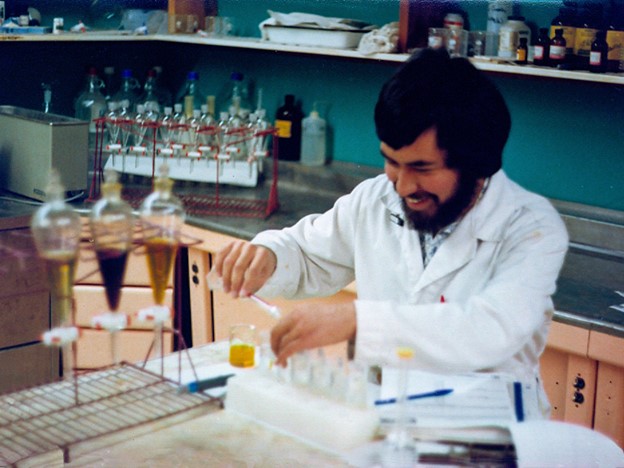
I served as part of the Joint Task Force during the 1977–1980 Enewetak Atoll Atomic Cleanup in the Marshall Islands. Enewetak Atoll, a chain of 38 islands, was once part of the U.S. Pacific Proving Grounds, the site of 43 atmospheric nuclear weapon tests, as well as biological weapons testing, missile, and space rocket testing.
Our workforce numbered around 6,000, a mix of civilian and military personnel. I was assigned to the Radiological Element of the Joint Task Force, a civilian led division comprised of experienced scientists, nuclear physicists, radiochemists, and experts from the National Laboratories, Defense Nuclear Agency, University of California, University of Hawaii, and the Department of Energy.
Before joining the cleanup, I worked as a Radiochemistry Technician at Eberline Instrument Corporation’s Health Physics Laboratory, as a health physics technician I specialized in bioassay and environmental analysis of radioactive elements and monitored radiation contamination. During the cleanup, I led an Air Force crew of seven. Our mission was to collect soil samples for the radiological survey. My work was instrumental in evaluating the nuclear contamination which determined what radioactive debris and soil were to be entombed within the ominous Runit Dome, a nuclear blast crater encased in concrete.
My crew and I were among 1,836 young men and teenagers who directly performed “hands-on” work in the restricted zones, the most contaminated areas, including the very “ground zeros” where nuclear weapons were detonated. All of us working in this dangerous area were without protective equipment. At just under 21 years old, I wore the same uniform as the military personnel: shorts and a t-shirt. Like many others, I used my t-shirt as a makeshift dust mask. We collected the toxic and radioactive soil samples with a small garden shovel and by hand, without gloves or any protective gear.
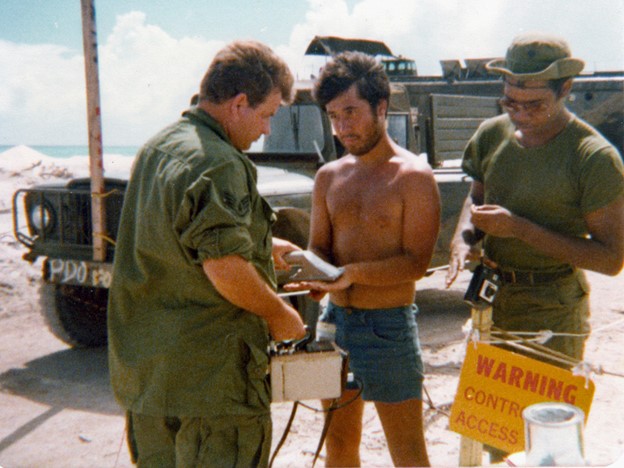
The Atomic Cleanup occurred during the Cold War, long before the information age. I was given only minimal information about the nuclear testing. Upon arriving at my first worksite with active cleanup operations on the contaminated islands, I was deceptively relieved to see no one wearing radiation protection. With no safety measures in place, I assumed the toxic and radioactive hazards were minimal. This assumption was tragically wrong. The islands where I lived and worked remain quarantined to this day due to the long lasting consequences and impact of the nuclear weapons.
Despite the immense effort, the Atomic Cleanup ultimately failed, not for lack of resources, talent, or dedication. The Joint Task Force brought together the most formidable atomic cleanup force that had ever been assembled. This included the Army, Air Force, Navy, National Laboratories, universities, and some of the best scientific minds of the time. Yet the task was impossible. Like all atomic cleanups, it was dangerous, wasteful, and ultimately futile.
Learn More About Sites Near You