This testimony was shared orally with one of us on January 29, 2025. It is edited for length and clarity and was reviewed by Tsosie before publishing. Since first sharing this, the Radiation Exposure Compensation Act (RECA) was expanded to include uranium workers employed after 1971.
Kerr McGee/Quivira Uranium Mine: Evie Tsosie
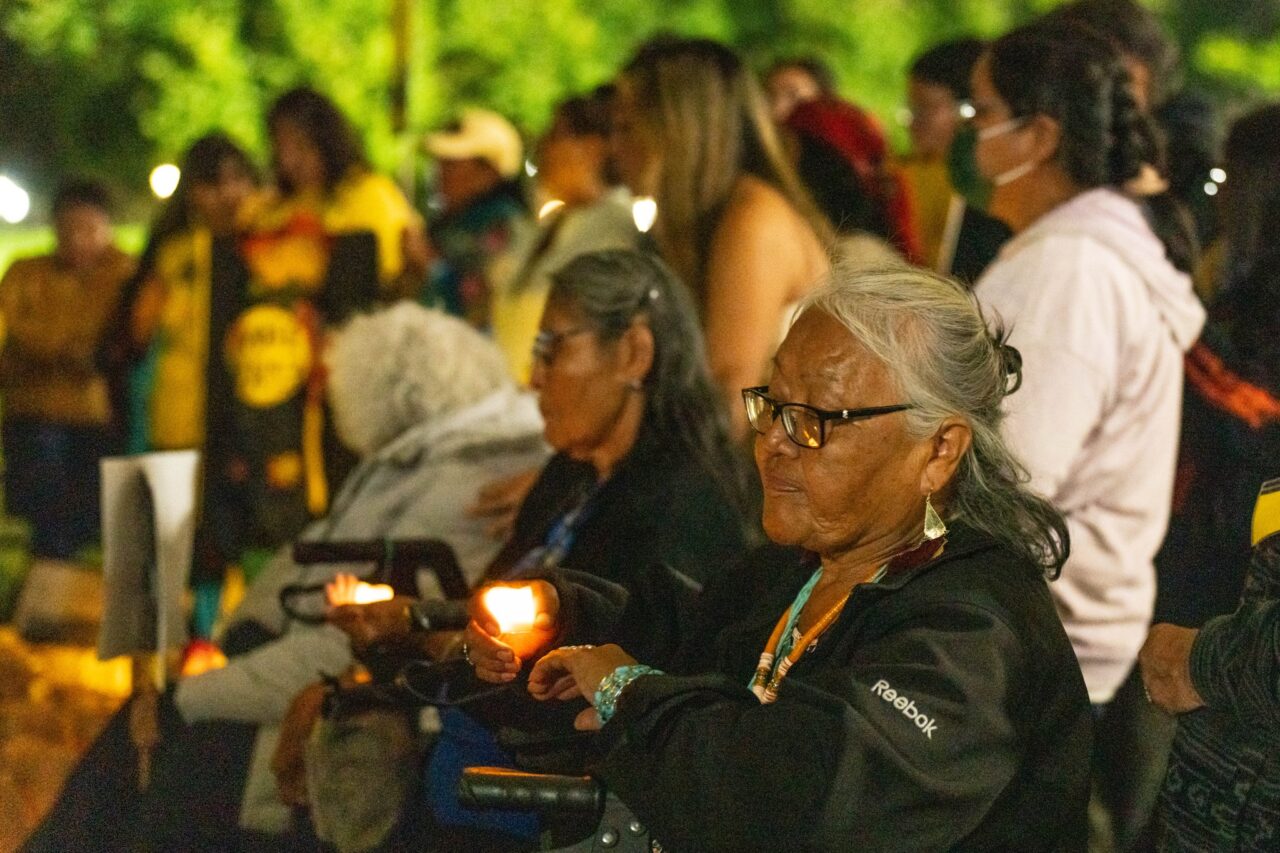
Evie Tsosie was born and raised near Kayenta, Arizona, in the iconic Monument Valley. This area of Arizona is also considered "downwind" of the aboveground nuclear tests at the Nevada Test Site.
Tsosie's dad worked in uranium mines during World War II in the 1940s, in what was then called "Navajo Camp." Since the workers weren't told about the risks, he'd bring his contaminated equipment and clothes from the uranium mine back home. After years of suffering from lung cancer and other chronic lung illnesses, he died from pneumonia.
Tsosie herself worked in uranium mines from 1976 to 1981, first in the Ambrosia Lake area near Milan, New Mexico, and then at the Church Rock/Quivira mine near Gallup, New Mexico, both of which were owned by the Kerr McGee Corporation. She remembers a lax approach to safety and health precautions at both mines. While they had dosimeters in their hardhats to measure their exposure to radiation, not much action was taken when readings were high. Tsosie mostly worked underground, but if her radiation readings got too high, as they did a number of times, she would be sent to the surface to work there. Once the levels went down, she would be sent straight back underground. No further action was taken.
Safety equipment like ear plugs, respirators, masks, and even boots and uniforms were available, but they all had to be purchased or rented by each employee, with the costs coming out of their paycheck. Sometimes certain items weren't available, and their use was not enforced. As a result, she often saw people working without the proper safety equipment. Similarly, the mining equipment the workers used wasn't checked regularly for safety. This was in stark contrast to her time working later in a coal mine, where a union strictly enforced safety precautions.
Tsosie also witnessed and was on the receiving end of sexual harassment and assault. She was one of only around a dozen women working at the Church Rock and Ambrosia Lake uranium mines, among more than a hundred men. She remembers women being cornered in the lunch rooms or after their shifts by male co-workers, who would try to kiss them or undress them, or threaten that they would lose their job if they didn't sleep with them. There was a culture of not reporting these incidents and of sweeping those that were reported under the rug. Tsosie learned to raise her voice, pushing back against both the men themselves and the company, and taking younger women under her wing.
Tsosie has been diagnosed with three cancers: twice with breast cancer and once with colon cancer. Though she is in remission, the care, travel, and logistics around treatment have often been daunting and expensive. There is a compensation program for uranium workers and downwinders called the Radiation Exposure Compensation Act (RECA). However, Evie is not eligible to apply for RECA as a uranium worker, since the current cutoff date for eligibility is 1971. Because she has also lived much of her life in a downwind-eligible area, including as a child during the period of nuclear testing, she was able to apply for and receive RECA compensation as a downwinder.
In September 2024, Tsosie traveled by bus from Albuquerque, New Mexico, to Washington, D.C., with dozens of other Indigenous uranium workers and downwinders, to advocate for extending and expanding RECA. She took this long journey in the hopes that Congress would improve the program so that miners like her who worked after 1971 could apply and get support.
Learn More About Sites Near You
Nuclear weapons impacts exist in all 50 US states.
See how they touch communities near you.